SCF Phase: Bio-Intelligence Recon Biological Analog: Cellular Subpopulation Mapping SCF Interpretation: Identifying hidden or niche cell states (e.g., senescent niches)



SCF CONCEPTUAL TRANSLATION DOSSIER
Subdomain Enumeration → Cellular Subpopulation Mapping for Hidden/Niche Cell-State Discovery
Document Code: SCF-DBI-SUBENUM-0003
Clinical Context: SCF Advanced Medicine Clinic (Non-Interventional Intelligence Layer)
Regulatory Posture: Preclinical / Systems-Intelligence / IND-Enabling Discovery
Framework: Synergistic Compatibility Framework (SCF)
INPUT (As Provided)
- Ethical hacking tool: Subdomain Enumeration
- SCF Phase: Bio-Intelligence Recon
- Biological Analog: Cellular Subpopulation Mapping
- SCF Interpretation: Identifying hidden or niche cell states (e.g., senescent niches)
I. Original Ethical Hacking Intent (Baseline)
Definition & Purpose
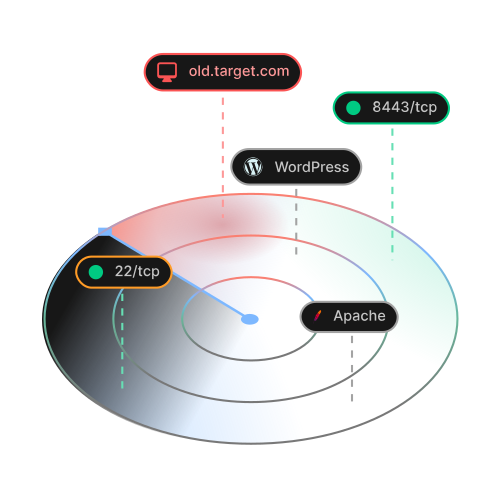
Subdomain enumeration is a reconnaissance technique used to discover hidden, internal, or non-obvious subcomponents of a digital domain that are not visible at the top level but materially affect security posture.
Commonly implemented via tools such as Amass and Sublist3r, its ethical objectives include:
Function | Cybersecurity Purpose |
Hierarchical discovery | Reveal internal services & boundaries |
Surface expansion mapping | Identify unseen attack surfaces |
Contextual risk analysis | Understand function-specific exposure |
Lateral structure awareness | Prevent blind-spot exploitation |
Core insight:
The most consequential vulnerabilities often exist in internal subdivisions, not in the primary interface.
II. SCF Translation Logic
Domain Hierarchy → Cellular Ecology
Biological systems mirror hierarchical digital systems: organs contain tissues, tissues contain subpopulations, and subpopulations harbor specialized states that dictate system behavior.
Cyber Concept | SCF Biological Analog |
Primary domain | Organ system |
Subdomain | Cellular subpopulation |
Hidden service | Dormant / senescent / progenitor niche |
DNS hierarchy | Differentiation lineage |
Enumeration | Phenotypic discovery |
III. Biological Re-Engineering Concept
“Physiological Subdomain Enumeration” — Cellular Recon
Functional Definition
A DBI-driven cellular enumeration layer that:
- Discovers non-dominant cell states within tissues
- Maps functional micro-ecologies (senescence, immune tolerance, repair niches)
- Identifies pathogenic persistence reservoirs invisible to bulk assays
- Outputs cell-state–specific biomarker panels
This directly addresses a major limitation of conventional histology and bulk omics.
IV. SCF-Aligned Architecture


A. Enumeration Phases → Cellular Mapping
Subdomain Enumeration Phase | SCF Cellular Equivalent |
Brute-force discovery | Broad single-cell screening |
Passive enumeration | Lineage-tracing & transcriptomics |
Recursive mapping | Sub-subpopulation identification |
Context correlation | Microenvironment & ECM coupling |
B. Key Targets Identified
- Senescent cell clusters
- Immune-privileged niches
- Viral persistence reservoirs
- Fibrotic progenitor zones
- Aberrant stem-like populations
V. Outputs: SCF Cellular Intelligence Panels
Cellular Subpopulation | Indicative Biomarkers |
Senescent niches | p16^INK4a, SA-β-gal, SASP cytokines |
Immune-silent cells | PD-L1, low MHC-I |
Regenerative progenitors | SOX2, OCT4, LGR5 |
Fibrotic initiators | TGF-β, COL1A1 |
Viral reservoirs | Latent viral RNA, epigenetic locks |
These panels enable precision targeting without collateral tissue disruption.
VI. SCF Five Principles — Direct Alignment
SCF Principle | Subdomain-Cell Mapping Contribution |
Targeted Drug Action | Enables cell-state-specific intervention |
Pharmacokinetic Optimization | Improves tissue-selective delivery |
Metabolic Efficiency | Avoids global metabolic suppression |
Resistance Prevention | Eliminates hidden persistence niches |
Safety Profile | Preserves healthy dominant populations |
VII. Implementation in SCF Advanced Medicine Clinic
1. Regenerative Immunology
- Identifies immune-blocking senescent niches
- Allows selective senolytic or immune-reprogramming strategies
- Restores immune surveillance without autoimmunity
2. SCF Gene Evolution & Engineering
- Distinguishes adaptive progenitors from mutagenic cell states
- Prevents editing of evolutionarily protective subpopulations
- Enables cell-state-specific gene modulation, not blanket editing
3. SCF Trauma & Emergency Medicine
- Reveals post-trauma fibrotic or inflammatory micro-zones
- Prevents maladaptive healing and chronic pain loops
- Guides early regenerative redirection
4. Maternal–Infant Medicine
- Detects placental and fetal niche vulnerabilities
- Protects early developmental cell hierarchies
- Prevents epigenetic scarring at the subpopulation level
VIII. Novelty, Differentiation & Unmet Needs
Novelty
- Treats tissues as cellular ecosystems, not homogeneous masses
- Moves beyond “average cell” biology
Differentiation
Conventional Medicine | SCF Subpopulation Mapping |
Bulk tissue analysis | Hierarchical cellular intelligence |
Symptom-based targeting | Cell-state-based precision |
Late intervention | Early niche disruption |
Unmet Needs Addressed
- Persistent inflammation without cause
- Post-viral and post-trauma syndromes
- Fibrosis and failed regeneration
- Developmental disorders rooted in niche failure
IX. Integration with Thai Chung Medicine Clinical Systems
Thai Chung Medicine emphasizes internal layers, timing, and balance rather than surface phenomena.
Alignment
- Subpopulations = hidden disharmony layers
- Senescent niches = stagnant Qi reservoirs
- Enumeration = deep diagnostic listening
This intelligence layer informs:
- When regeneration is blocked internally
- Where balance must be restored before stimulation
- How to sequence therapy in harmony with tissue readiness
X. Summary
Subdomain enumeration teaches us that the real system lives beneath the surface.
Within SCF, this becomes:
Cellular Recon →Hidden Niche Discovery →Precision Regenerative Targeting →Durable Systemic Healing
MASTER DOCUMENT REGISTRY INDEX
SCF-MDR-DBI-SUBENUM-0003